Friday, 17 May 2013

The magic of theater comes alive


There is just that something about theater that comes alive on gala night. All these weeks of hard work suddenly seems to have special meaning. Those jokes you have seen a million times during rehearsals suddenly just seem so funny again when the whole crowd cracks up.

Well done to the whole cast cast and crew of Protea Stage Productions to bring their latest show, bottoms up to life tonight.


Monday, 13 May 2013

More on budgeting - The DIY concept - Doing a concept album under a budget

Did my last post about budgeting for a concept album give you a scare? Well, good for you. That was the idea.

The good news is that you can do it much cheaper. There are many ways that you can save cost by doing some things yourself. The bad news is that some of these things you can do may compromise on quality if you do not know what you are doing. However, if you are vigilant you may get away with a very reasonable quality product.

For example, we have seen how a session musician may want to charge you a two session price for strumming a guitar on a single song. If that sounds excessive, that is exactly what it is. That is what the going rate is. That is what unions do. Unions are there to ensure unemployment for their members. Keeping prices unaffordable for the small entrepreneur like you and me. If you can play a reasonable guitar, you can strum that guitar yourself. It may however not sound as good as the session musician, recorded by a professional engineer. You may not have the same quality gear or the same skills - and this is where the vigilant part comes in.

Start thinking like a business man here. We have 20 songs, each track will cost you 2 sessions for a musician, plus one hour studio cost; i.e. a total of $400 per song. Multiply this with 20 songs to give you $8000, just for strumming guitars on your 20 songs!

What can you do with $8000? For one, you can buy a reasonably good quality guitar for less than $500, but if you really go for the top of the range, splash out around $1000 and you are assured to have a sound as good as that professional. You also will need a very good microphone. For about $100 you can get a cheap mic, but, I would recommend that you go for the $500 range to get the best quality. You will also need a reasonably good set of headphones, which would cost around $200. Let's assume you already have a good computer with a good recording program. All you would need is a quiet place where you can record you guitar and you are set to go. For about $2000 and lots (yes lots) of time, you can have your guitars recorded and save yourself $6000!

The only variable we have now is your own skills. Look at it this way. If I'd pay you $6000 cash to practice, how much would you be prepared to sit down and practice? 5 days? 10 day? I'd think more. So all that is left for you is to sit down and practice. There are thousands of internet sites giving advice on how to practice. Remember, we are just talking about strumming your guitar here. We have not even looked at the fingerpicking and guitar solos yet. Adding the possibility to do the finger picking parts, electric guitar parts, and the guitar solos, you may be able to save yourself a whopping $20,000 to $30,000, just by doing all the guitar parts yourself. That is not bad hey!

Remember, this is a concept album recording. You do not need to have Eric Clapton playing the guitars.

Off course, you will have to also learn a few other things in addition to playing the guitar. That studio owner and recording engineer was not sitting around doing nothing. You will have to learn how to best record a guitar. Trust me, you don't simply switch on a microphone and start recording. Google is you best friend here and you may want to spend many (yes, many) hours reading books and trying different ways. You will have to be prepared to re-record a song many times until you have the best take. Does 10 times recording the same song scare you? Wake up then, cause you might have to do it 20 times for each song.

Going this route has many other advantages. You are not limited to only one strumming part per song anymore. You may choose to record your guitars in stereo by recording different parts for left and right. You may even get creative by overdubbing certain parts and add fills and thrills. All for free. A song like Hotel California has at least 10 guitar parts double tracked.

This gives you an idea on how to save costs - lots of it - when doing a concept album. The same idea may apply to all your other instruments. Ever wanted to start playing the drums? What about piano? Bass guitar? Violin, cello, saxophone, trumpet, etc. We can get really creative......but......

Fact is, not everybody is able to play musical instruments, especially not that many different ones. Even if you were able to learn to play all those instruments, it may take you many years to become reasonably skilled in all of them.

Next time we will look at other ways of doing it. Help is out there. We just have to find it. You do not really have to play the drums and trumpets yourself, and still get away without it costing you anything.


Sunday, 12 May 2013

Budgets for a concept album

Since we started to chat about the concept of a concept album, we touched on a few ideas. We talked about what a concept album is, and why we want to record a concept album. I also talked about the broad process of making such concept album.

Tonight I want to talk about how we start to plan the concept album. Let's assume for now we have written our play and we have written the songs. So now we have between 20 and 30 songs, totalling about 2 to 2 and a half hours of music. Now we must decide which song we will include on the concept album.

Before I go on, let me say that there is no rule here. The best I can do is give you an idea of what my thought process was when I did the concept album for The exile.

Ideally, we would want to record all the songs, but let's think about it for a moment. At this stage, you greatest considderation is the cost. If money is no problem, I'd say go for it and record every song. Unfortunately, in my case, money was not free flowing and I had to set myself a budget.

When you set your budget, start by listing all the songs. For each song, record the number of instruments needed. Split this by the number of instruments you can do yourself and the number of instruments for which you will have to hire session musicians. If you are lucky, you will get enough friends together who will do it for you for free. In my case, I did not get enough friends together, mainly because I do not have friends. Count each vocalists line as an instrument. If a vocalist is needed for only 2 seconds, you will still have to count him or her as one instrument. This is where the big chorus songs can become expensive. If you need a chorus with 16 voices, count each one separate, i.e. 16 instruments. Even if you plan to get one person to record 2 or 3 lines in harmony, it would still take 2 or 3 separate recordings, therefore you must count them as separate tracks. Some session musicians would charge you full price for the first line and then half price for each extra line, but more about that much later.

Depending on the complexity of your music, time needed to record a song may differ significantly, but let's work on more or less averages. Most song would need two (2) sessions per instrument, i.e. a session for the musician to get to know your song, and one session to record the instrument. Union negotiated rules differ per country, but usually provide for 3 hours per session. Current rates are about $150 per session, or R1,500 in South Africa.

Just a brief note here. Most union rules limit a song to 5 minutes maximum. You do not get discounted rates for less than 5 minutes, but there is a very complicated formula for calculating costs for each minute in excess of 5 minutes. For now, let's keep all our songs below 5 minutes.

A few simple calculations may now give you a rough baseline budget; for each song you must have the number of tracks to be recorded (T), and the cost per session (C). Here is the formula:

The total budget for a track = T x C x 2

Let's take an example: I have a song that needs an acoustic guitar strumming, doubled by an acoustic guitar finger picking, an electric guitar playing rhythm, a solo electric guitar, a bass guitar and drums. For vocals I need one male and one female singer. Each singer needs to harmonize for the chorus. This all gives me 6 instruments plus 4 vocals, i.e. total 10 tracks. The budget for this song is therefore 10 x $150 x 2 = $3,000.

Calculate the cost for each song in this way and add up all the costs. Let's for simplicity assume all songs need the same number of tracks and we have 20 songs in total. A very quick calculation gives us the total cost of musicians for the recording at $60,000. Add to this your studio time of about 6 hours per song at $100 per hour and the producer at about $300 per song. The studio time usually includes one recording engineer, but specialists like drum recording engineers are usually extra. This gives us an extra $18,000. To this you will have to add the cost of a mixing engineer, a mastering engineer and then the cost of making the CDs. In all the cost for your album will probably exceed $100,000 by now.

Good news?

For most of us, this sum would frighten us and we would give this up as a bad idea.

But....

Do not not give up this easy.

Next I will show you how we can bring this cost down to about one tenth of that cost by being clever.


Friday, 10 May 2013

A much needed day off

Today we have the day off.

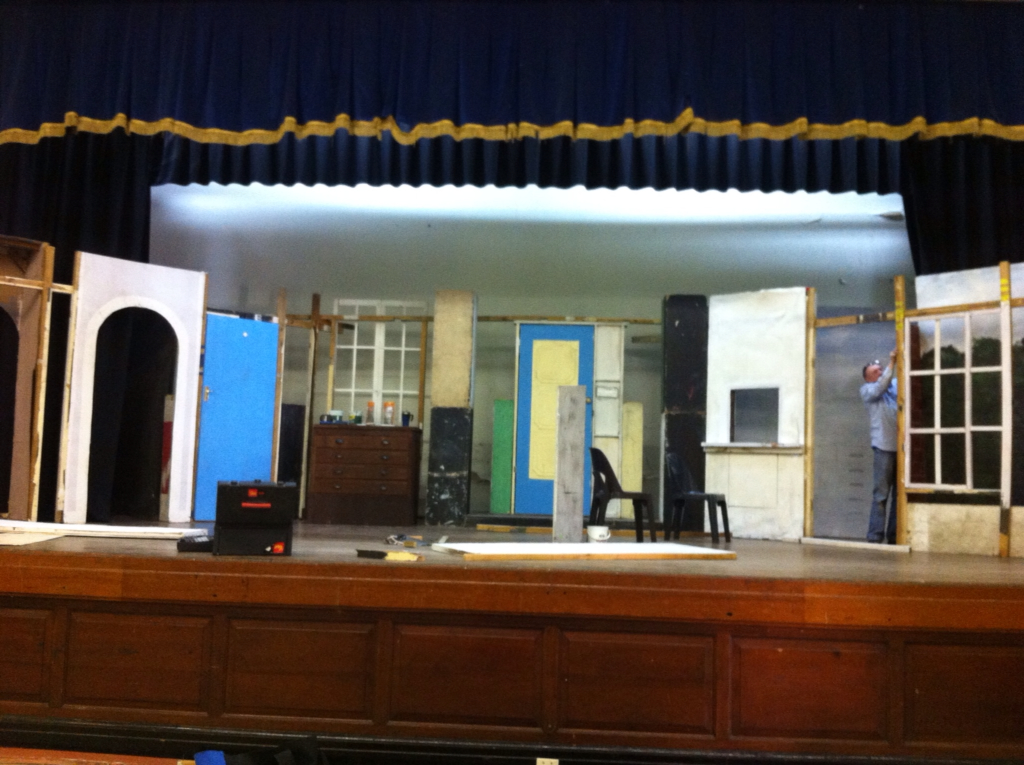
This is much needed after a week that I have barely seen my home. Last Sunday, Protea Stage Productions moved into the town hall. All this excitement is all about our play for the year, a farce called Bottoms Up. The gala night is next Friday May 17th. If anybody is around Benoni the next few weeks, please come and support us. Protea is a not for profit, community production company and would really appreciate any extra support.

The following series of photos show how we built up the stage set.


Watch this space for the final pics, and off cause the show.!!

See you there.

Thank you for the support.


Sunday, 5 May 2013

Moving in!

Today we (Protea Productions) moved into the City Hall. My back is off!

My day started at about 8 O'clock this morning when we packed the set up into the trailers, and we worked all the way through to about 5 O'clock the afternoon. At least we got all the heavy stuff built up now. Tomorrow we'll patch up the walls and holes and start painting. Dress rehearsals on Tuesday.

Hope I will make it through this week. Don't think there will be time for writing any songs this week. At least I wrote 3 songs last week, so I think I am half a step ahead.


Friday, 3 May 2013

What is a concept album?

Let's kick off our discussion about the making of a concept album with a short discussion about what a concept album is.

Well, actually, it is not that difficult to figure out what it is from the name. It however get a bit confusing when you start to look at all the many options, so let's look at all those funny names given to these albums.

If you'd google any musical's name, with the word 'recording', you may find a wide variety of albums. Musicals tend to be recorded and re-recorded many times. It is not so simple as other musical works for which usually only one or two versions exist. Try it out. Go into your local shop and ask for the recording of Phantom of the opera. You are likely to just get a blank stare from your shop attendant, but let's assume for this argument that your shop attendant knows a lot about musicals and musical recordings. If she does, she might reply with "Right away sir. Which album would you like?".

Unless you know a little bit about recordings of musicals and specifically the musical you might be interested in, your shop attendant will at this point be met with a blank stare. Upon such situation, your shop attendant is most likely to hand you the latest available recording, which just might happen to be the 25 year anniversary concert album. Failing that, she would likely give you the original London cast recording.

For most musicals, the most popular and best known recording would be the original cast recording. That is usually either a Broadway or a London cast recording, but might be anywhere else in the worlds as well. This all depends on where the world primiere for your musical was held. The important word to look out for here is 'original'. The album is usually assgned the status of 'original cast recording' and a year, indicating that this is the recording of the cast of singers and actors who initially did the Broadway or London primiere show. Most often, this is the album that may contain the version of the recording of the songs that made it to the hit parade.

But not always.

Sometimes the song that you have heard on the radio comes from any of the other possible recordings. Sometimes you might be looking for the 'studio cast recording'. These are albums often recorded after the premiere is over and the composers never bothered with the original cast recording. Often the popularity of the show exceeded expectations and the composers decided that an album might be a good idea to make extra money, so they got a bunch of session musicians together to record the songs. But not always.

Often the studio cast recordings are done before the premiere and is done with the purpose of creating interest in the show. This is where the concept album often comes in. Jesus Christ Superstar is a great example of this. ALW recorded the songs from the musical with well known musicians to spread the word. The concept album would very often be followed by an original cast album, but not always. The songs on the concept album might often not be exactly the same as the songs in the cast albums. That is the whole idea of a concept album. It gives the composer the chance to check things out and change it to his liking.

Often you will get a demo album recording in the place of the concept album. Often the quality of a demo recording would not be as good as a concept album recording, but again, this is not always so. With recording technology more affordable and in the hands of the average man, quality of demo recordings are pretty good nowdays. The difference between demo albums and concept albums have become blurred and these names are now used interchangebly. Demo albums are usually not available commercially.

We've already talked about the original cast recordings, but there can be any number of cast recordings. If a musical is very popular, you may find that every producer anywhere in the world may want to make a recording of his cast. These albums would usually be indicated with some town and a year.

When a movie is made of the musical, you may find a soundtrack album. In many cases these albums would have the movie actors singing the songs, but not always. It use to be common practise to have session musicians sing the songs and the movie actors just lip sync in the movie.

Another popular option is the concert album recordings. These are when a number of great performing singers perform the songs in a live show. You would most often hear the crowd clapping in the background and between songs. Many Stephen Sondheim shows have very good concert albums available.

There are many other options as well. The songs from.. albums are very popular. These albums often mix a number of musicals from the same composer. You may even find a greatest hits album or often a popular singer sings albums. Barbara Steisand made a number of great recordings singing her favourite songs from her favourite musicals. Often these recordings make it to the hit parades and are more popular than the cast recordings.

Then there are many more variations for fun and commercial gain. There are dream cast recordings, symphonic recordings, highlights from albums, film score albums, karaoke albums, and the list goes on and on.

From this short discussion, you might get some idea of all the variations on the theme available. Have a look at some of the links provided above just to get a feelng. The thirty two pages with 373 recordings of Les Mis on Amazon would seem a bit extreme, but at least, I hope I helped a little bit to help you make some sense of it.


Thursday, 2 May 2013

Making of a concept (or demo) album

Following from the previous post about why the concept of concept album is a good idea, I want to relate some of my experiences in the process of making the concept album. Making a concept album or a demo album, or even a commercial release album all basically go through the same process.

I have this terrible feeling of deja vu about this post, so if in another dimension of life you find another post by me that looks very much like this one, please blame it on apple and blogsy software that contains bugs beyond my own comprehension.

Let's start this series of posts about making the concept album by giving it some structure. I will do this by breaking the process down to a number of smaller processes:

  1. Songwriting: First there have to be a song. Without a song to record, there will be only noise. Nothing wrong with the concept of an album with noise only, but that will be regarded as outside my genre for the moment. I have touched on this part in previous posts, and as we go along, I will dedicate some more posts on this subject.
  2. Recording: When we have a song, we want to get it into a way that others can listen to it. This is the process of making noise in some harmonious manner. The recording process usually includes recording of some instruments and some vocals. There might be any number of instruments and it may or may not actually involve humans plying them. More about all this in future posts.
  3. Mixing: Usually, the recording process involves recording every instrument and every human voice separately. In fact, with modern computer technology being available so cheaply, it would be silly to try and record everything in one single go. Once you have a recording of somebody singing, and another recording of somebody playing a guitar, you must put these two recordings together. This is called mixing. Mixing usually involves putting many recordings together in a way that it sounds good and do not become just one huge noise. This is done by adding effects like equalization, reverb, delay, etc. Finally, the song will be "mastered", which simply means that it is turned into a format (CD, mp3, etc.) which can be used in the next stage.
  4. Manufacturing: Not all recordings ends up on CD. I will nevertheless touch on the process of creating a CD or other physical product at some stage.
  5. Marketing and business: I will add the business part all under one heading. We can call this the "record company" part of the process. Most concept albums are not made for the purpose of making lots of money. You goal may be to use it as a tool to sell your show, or it might simply to be for your own pleasure.

In future posts, we will talk more about all these tasks and processes, and I will give you some insights into how I went about it for The exile,